Thanksgiving potluck ideas for organizers: 12 ways to run it well
A good Thanksgiving potluck is mostly decisions the organizer makes before anyone brings anything: what you assign, what you cap, and which slots you name. These twelve ideas are for the person running it, not the guest looking for a dish to bring.
If you are a guest looking for a dish to bring, read what to bring to Friendsgiving instead.
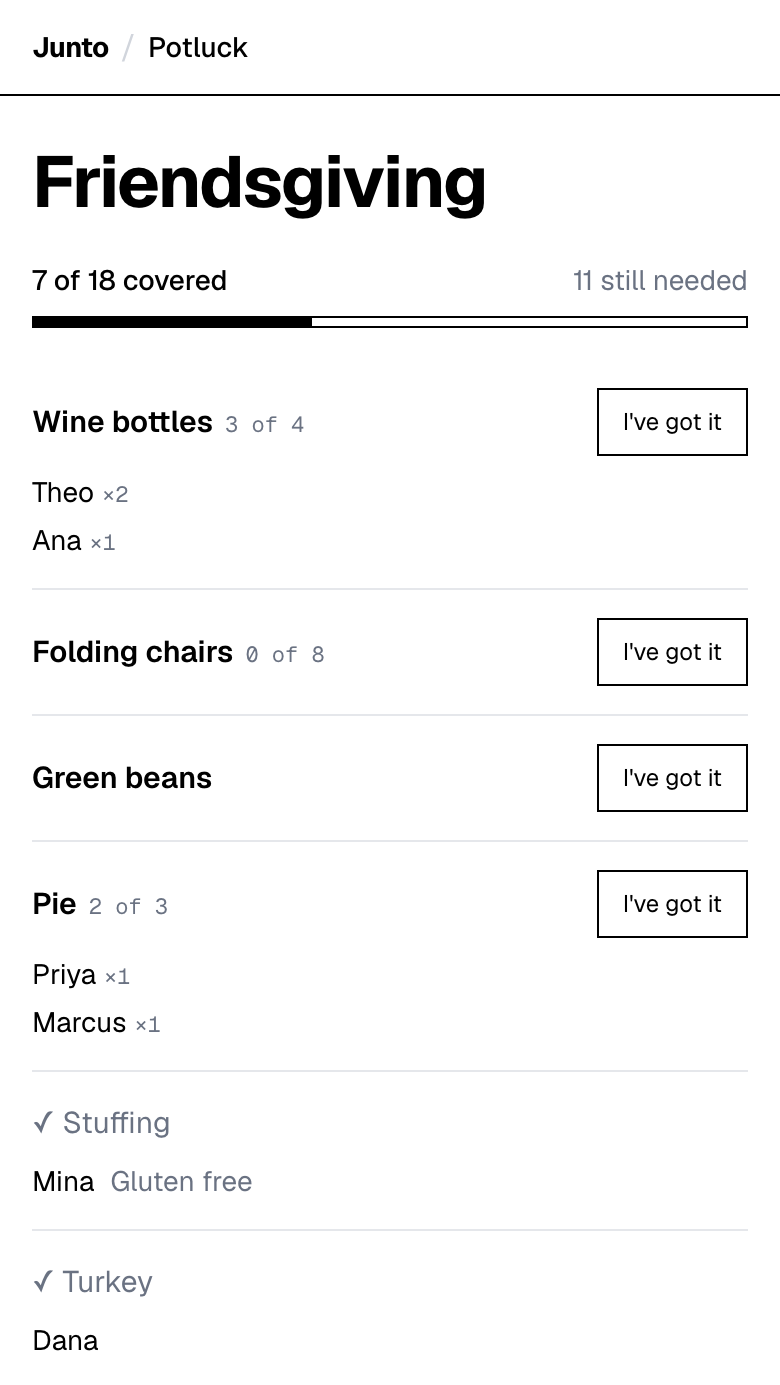
Turn these ideas into slots on one page. Guests tap an item and type a name. Free, with no account, no app and no ads.
How do you decide what to assign?
Assign the pieces everything else depends on, then let people choose the rest. The first three ideas are about that order.
- Claim the anchor yourself. Whoever hosts takes the main, usually the turkey, and writes it on the list under their own name before anyone else sees the page. It tells guests what the meal is built around and stops a second turkey. The sourced rule is 1 pound of whole turkey per person. If you are not the host, make the host's anchor the first line of the list anyway, with their name, so guests see the meal has a center. Then add the quantity of turkey you need from the table on the who-brings-what page.
- Assign by role, not by recipe. Ask for "a starch", "a green" and "something sweet" and let people choose the dish. You get variety without having to know what anyone cooks. Add a quantity to each role if you need more than one. Roles also make dietary coverage easier, because you can ask for "a green that is vegetarian" without prescribing a dish. People who like to be told what to make can still ask you, and people who hate it are free to surprise you.
- Keep two or three wildcard slots. Mark them "anything you like". They are for the friend who hates being told what to make, and they fill the gaps that a rigid list leaves. Wildcard slots are also your safety margin. If two friends drop out, the open slots absorb the loss, and you can ask a late responder to fill the exact gap instead of adding another random dish at the last minute.
Which themes work for a Thanksgiving potluck?
A theme narrows the guesswork. Pick one only if it makes choosing easier, not harder.
- Family recipe swap. Everyone brings a dish from their own family and a link to the recipe. Organizers and guests who add an item can attach an optional note or link, so the recipe sits next to the dish on the list. It is free text, and a guest cannot edit it later. Ask each cook to name the family member the dish comes from in the note, which turns the list into a table full of stories. Keep the note short, because a guest cannot change it afterwards, and the link should go straight to the recipe.
- One color per course. Orange sides, green sides, a white starch. It sounds silly, and it stops six brown casseroles. It works because it limits the choices without telling anyone what to cook. Give each course a color on the list, such as "orange side" or "green side", and let guests decide whether that means squash, carrots or beans.
- Dishes from where you are from. Ask each guest to bring something from their hometown or heritage. It gives the table a story without you inventing one. This works well for a mixed group of friends or coworkers, because it gives every person a reason to say something about themselves. Suggest it in the invitation instead of enforcing it, and keep a few ordinary slots for guests who want the classic dish.
How do you tell guests the rules before they sign up?
Put the rules in the invitation, not on the list. One short paragraph is enough: the theme if there is one, the dietary slots you want covered, and the date by which you want the list full.
Then let the list do the rest. Guests read the invitation once and the list many times, so the list should show only items, quantities and names. Rules that sit on a page people check daily become noise, and rules in a message people read once become a plan.
How do you cover vegetarian, gluten-free and other dietary needs?
Name the need in the slot, then trust that someone will take it. A list that says "vegetarian main" gets a vegetarian main.
- Put the diet in the item name. "Vegetarian main", "gluten-free dessert", "nut-free side". The sign-up tool has no dietary field, so the title does the work. Do this for every diet you have to cover, not only the loudest one. A guest scanning the list on a phone reads item names in a second, and they read notes only if they tap an item, so the name is where the information has to live.
- Ask for a note on every dish. A guest taking an item can add a short note, such as "Contains dairy". It is free text and cannot be edited after saving, so ask people to get it right the first time. Write the request into the invitation: "When you take an item, add a note if it contains nuts, dairy, gluten or meat." It takes a guest ten seconds, and for a friend with an allergy it is the most useful line on the page.
- Set a house rule for a serious allergy. If one guest has a nut allergy, say "no nuts in the sides" in the invitation and put an ingredient card by each dish on the day. If one guest has a serious allergy, call or message them before the list goes out and ask what they need. A list cannot replace that conversation. Then share the rule with everyone who is cooking, and ask them to keep packaging so ingredients can be checked.
How do you keep the potluck from turning into ten desserts?
Put a number on the things people love too much. Pie, 4 closes after four people claim it.
- Cap desserts. Set a quantity on the dessert items instead of a free-for-all category. The who brings what lists show our planning counts for each group size. The simplest cap is a number on the item: "pie, 4". When the fourth person claims it the slot closes, and the next friend sees what is left. If you want more variety, add a second item such as "cookies or bars, 2" so the sweet slots do not all go to pie.
- Give savory slots first. Open the list in two steps. Post the savory items first, then add desserts when the sides are covered. Opening in two steps feels like extra work but it takes one edit. Post the sides and mains, wait until they are covered, then add desserts. Friends who want to bring something sweet will wait for the slot, and the ones who cook for a living will not mind.
- Add a "supplies" tier. Plates, napkins, serving spoons, ice, foil and containers for leftovers. These are the slots that rescue the meal, and nobody thinks to claim them. Make it its own group of items at the bottom of the list: plates, napkins, serving spoons, ice, foil, containers, folding chairs. These are the items that decide whether dinner runs smoothly, and they fill fast when they are named and numbered.
Turn these ideas into slots on one page. Guests tap an item and type a name. Free, with no account, no app and no ads.
Questions
What is a good theme for a Thanksgiving potluck?
A family recipe swap works well: each guest brings a dish from their own family. A color-per-course rule also helps avoid six brown casseroles. Junto lets you attach a recipe link as an optional note on an item. Pick one theme and say it in the invitation.
How do I make sure there are vegetarian options?
Name the slot, for example "vegetarian main", and cap it at one or two. A guest looking for it will find it on the list. Junto has no dietary field, only a free-text note on an item, so the item title carries the diet. Add one vegetarian main to your list today.
How many dishes should I assign for a Thanksgiving potluck?
It depends on headcount. Our planning counts run from about six dishes for 6 guests to about 20 for 30 guests, including starters and desserts. They are planning choices, not sourced numbers. Junto holds them as items with a quantity. Copy the matching list from the who-brings-what page.
Should I assign dishes or let people choose?
Assign the anchor and the roles, then let people choose the dish. That gives variety without a spreadsheet of demands. Junto handles the roles as items with a number, and a full item closes. Keep two or three open slots marked "anything you like" for the friends who resist instructions.
Sources
- University of Nebraska-Lincoln Extension: Turkey 101 (1 pound per person) (checked 2026-11-03)
Related
- Guides: What to bring to Friendsgiving: 12 easy ideas for guests
- Use cases: Thanksgiving potluck sign-up sheet for the whole family
- Use cases: Office Thanksgiving potluck sign-up that coworkers use
- Guides: Friendsgiving who brings what, by guest count (6 to 30)
- Use cases: Potluck sign-up sheet: pages for every kind of event
Last updated 2026-11-03